
Which Concord Records Are Open
Concord is the Cabarrus County seat, but no single city desk controls its record system. The custodian, meaning the office responsible for a file, changes with the subject. County offices hold deeds, tax rolls, vital certificates, local jail data, and trial-court files. State agencies maintain correctional histories and registries. An online index is a finding list, while a certified copy carries the keeper’s official authentication. A parcel is one mapped unit of land.
| Concord record | Office that keeps it | Web coverage | Access route |
|---|---|---|---|
| Deeds, liens, plats, assumed names | Cabarrus Register of Deeds | Party-name index from 1983; reindexing covers 1938-1982 | Web index when available, older index books, counter, or phone |
| Property and tax roll | Cabarrus Tax Administration and GIS | Current owner, parcel, address, and map tools | Free web search; assessor and GIS help lines |
| Civil, criminal, estates, divorce | Clerk of Superior Court | eCourts in Cabarrus since October 14, 2024 | Portal, courthouse terminal, clerk file, or certified-copy request |
| Birth, death, marriage | Register of Deeds and NC Vital Records | Local indexes were offline when inspected | Eligibility-based online, mail, or counter order |
| Current jail custody | Cabarrus County Sheriff | Current inmate name search | Free P2C search; clerk confirms case disposition |
| State offenders and registry | NC DAC and NC SBI | State correctional and qualifying registrant databases | Free official searches |
Access to these public records has limits. Sealed or expunged cases, juvenile and adoption files, protected voter details, newer military discharges, and investigative material can be closed or restricted. North Carolina also withholds Social Security numbers and certain account or identity data found inside otherwise open files. The agency should redact those fields and release any separable public part.
North Carolina Opens Concord Records
North Carolina Public Records Law, Chapter 132, defines a government record by its public business, not its format. Paper, email, maps, photographs, audio, and database entries can all qualify. Any person may inspect an existing record. A requester does not have to live in North Carolina or state a purpose. The custodian must provide inspection or copies “as promptly as possible,” but the law sets no fixed day count.
Inspection is free. An ordinary uncertified copy can cost no more than the direct cost of reproduction, without routine agency overhead. A request that needs extensive clerical or technical work may draw a reasonable special service charge. The office does not have to create a new record, build a custom query, or compile information it does not already keep.
If an office denies access, ask for the legal basis in writing. Section 132-9 allows civil enforcement, and a requester who substantially prevails may qualify for attorneys’ fees under the statute. A precise request often resolves the issue sooner than a broad demand.
Note: North Carolina law favors release of the open portion after confidential fields are removed from a mixed record.
Cabarrus Deed Records by Era
The Cabarrus County Register of Deeds records deeds, deeds of trust, liens, plats, condominium plans, assumed names, and notary material. Its modern land index supports party-name searching from January 1, 1983. A county-approved project is reindexing the years 1938 through 1982, which had required browsing virtual images of older index books. Still earlier instruments remain accessible through time-framed books and help at the office.
The official land and vital index was down for vendor maintenance when inspected on July 28, 2026. That outage makes the fallback important: call 704-920-2112 or visit the register’s counter at 65 Church Street South. Staff can direct a search, but they cannot select a legal form, draft an instrument, or give legal advice.
An index points to an instrument. It is not the instrument itself. A grantor is the person giving an interest, while a grantee receives it. Book and page or document references lead to the recorded image and make it possible to order a certified copy.
Note: Recording closes at 4:30 p.m., half an hour before the Register of Deeds office closes on weekdays.
Search Concord Property Records
The Cabarrus Real Estate Search provides a free way to locate a taxable owner or parcel before consulting a deed. It requires at least one field. Its inventory comes from deeds, plats, and other public data, so the county tells users to confirm important facts against the primary record. A parcel is a mapped unit of land; it may not match a street address exactly.
| Search field | Input | How it narrows results |
|---|---|---|
| Owner name | Last name and first name | Finds the taxable-owner trail |
| Account or parcel | Account number or four parcel parts | Targets a known tax account or mapped tract |
| Property address | House, unit, direction, street, type, suffix, municipality | Separates similar street names and city areas |
| TMP | Five map-related parts | Uses the county tax-map reference |
| Land size or zoning | Numeric range and dropdowns | Filters a broad result set |
Map Cabarrus adds parcel boundaries, jurisdiction, zoning, schools, flood areas, and historical aerial photographs reaching 1938. That long image run can show whether a building existed when an old deed or directory placed a family there. Its parcel panel can also lead to deed, plat, tax-card, and map details.
Concord Court Records After eCourts
Cabarrus County District and Superior Courts joined the statewide eCourts system on October 14, 2024. In eCourts Smart Search, a basic query accepts a record number or a person or business name. Advanced tools narrow by Cabarrus location, party name, date of birth, case type, status, or filing date. Hearings and judgments have their own search modes.
A docket is the case’s running register, not a full account of every document. Public results can include the case summary, parties, assignments, events, causes of action, dispositions (case outcomes), hearings, and some financial information. Judgment results can show case number, status, index date and time, parties, and comments. Confidential proceedings and protected fields remain hidden.
When the portal is incomplete, use a clerk self-service terminal or ask for the paper or electronic file. Criminal terminal searches can use a defendant name or case number, and civil, estate, and nonconfidential special-proceeding records are also available. The clerk in the county of filing supplies a case copy or certification. Cabarrus also received a public eCourts kiosk with scanning, printing, and payment functions in June 2025.
Note: A portal result helps locate a case, but the Cabarrus clerk’s file remains the source for an official copy.
Concord Vital Records Need Eligibility
North Carolina does not use a simple rule that automatically opens births after 100 years or deaths after 50. Section 130A-93 restricts particular fields and controls who may obtain a certified copy. Limited birth information, such as a child’s and parents’ names and some geography, may be public. Parental street addresses and Social Security numbers are not.
The Cabarrus Register of Deeds issues certificates for locally filed births, deaths, and marriages. Eligible recipients include the person named, listed relatives, authorized representatives, and people asserting a qualifying legal or property right. The local certified-copy fee is $10. A statewide birth abstract for many North Carolina births from 1971 forward costs $24 through Cabarrus, though exclusions apply to older, adopted, delayed, uncertain-fact, and full-image records.
Online orders require both sides of a valid government photo ID. A mail request needs record details, relationship, signature, photo ID, a stamped return envelope, and a check or money order sent to PO Box 707, Concord, NC 28026-0707. The counter accepts cash, check, Visa, or MasterCard. Historical marriage bonds from 1792 through 1855 are at the State Archives, with indexes at the register; originals from 1856 forward remain local.
Note: An unsuccessful statewide birth search still incurs the statutory search fee, so check Cabarrus eligibility and record details first.
Concord Jail Records Search
The Cabarrus Sheriff’s P2C inquiry handles current county jail information. It accepts optional first and last names and can filter the inmate list. Arrest or charge data can change, and a person shown there is presumed innocent unless a court finds otherwise. For the final disposition, contact the Clerk of Superior Court at 704-262-5500.
The Cabarrus Sheriff inmate inquiry shows the live name-search interface.
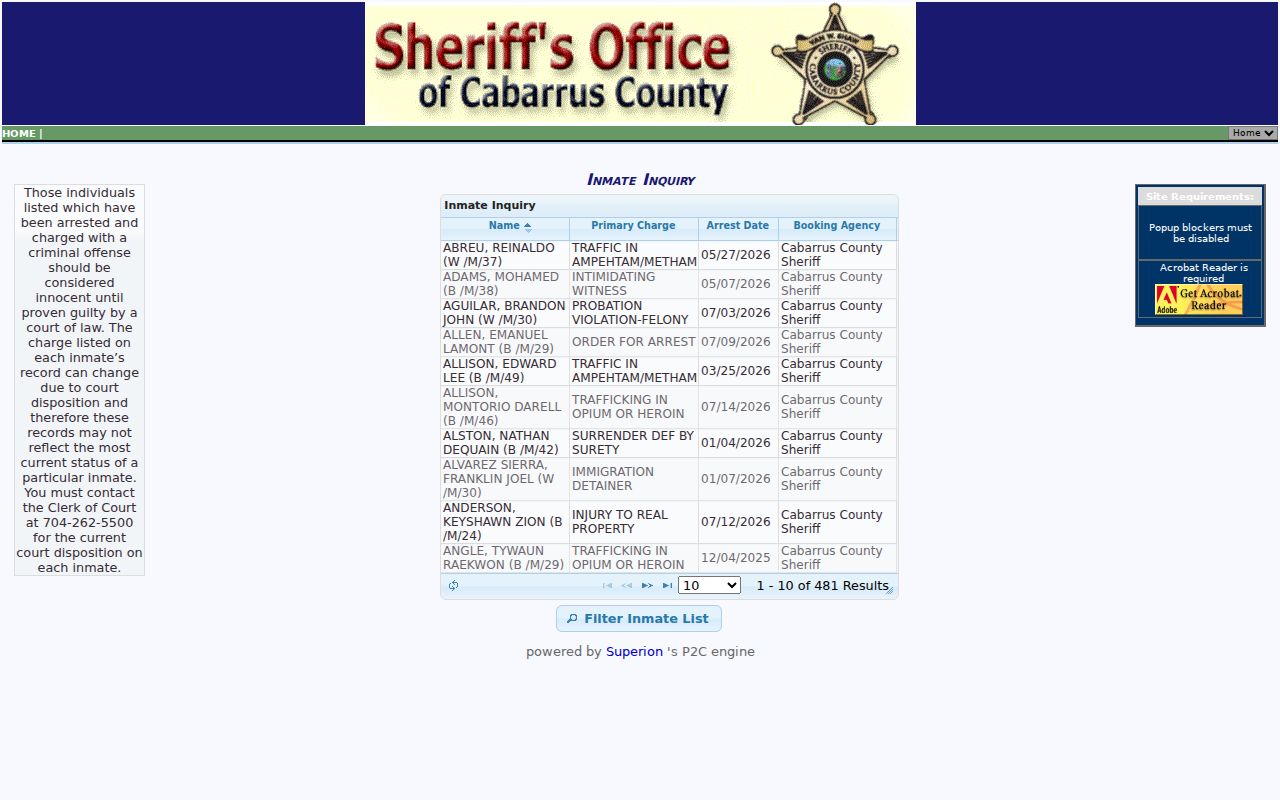
The screen separates first- and last-name input from the full list, which helps distinguish a direct search from browsing current custody.
Concord Registry Search Boundaries
The state correctional locator covers current and former prison or parole populations, not Cabarrus jail custody. A separate public-safety system covers qualifying registrants. Keeping those sources distinct prevents a county arrest entry, a court result, and a state correctional record from being mistaken for the same event.
The North Carolina Sex Offender and Public Protection Registry supports name, city or ZIP, registration number, address radius, and map-based searches.
The registry view makes its geographic options visible, including one-, three-, and five-mile radii. It covers qualifying registrants from the registry era, including certain nonresident workers and students. An absent result is not proof about a person, and the data should be used only for lawful safety purposes.
Note: Registry publication began in January 1996, so the database is not a complete history of every earlier offense.
A Fire Changed Concord Estate Records
A courthouse fire in 1875 destroyed Cabarrus records, including most original wills. That loss changes the search path for an estate. Will Book 1 began in 1843, and court minutes contain copied wills from 1830. Surviving originals are concentrated among surnames beginning with H, M, W, and Y; later material was copied into Will Book A.
Do not treat a missing original as proof that no will existed. Check the Clerk of Superior Court’s estate file, will books, court minutes, and the State Archives’ Cabarrus holdings. The archives guide also points to land, tax, court, and miscellaneous records. Its miscellaneous group spans 1794 to 1945 and includes coroners’ inquests, jury lists, exemptions, correspondence, incorporations, and grand-jury reports.
This records-history gap is especially relevant to heir and family-history work. A copied entry, deed transfer, marriage record, or later estate paper may preserve a name that the burned original can no longer supply.
Note: Verify each estate against both Cabarrus clerk holdings and archive copies because survival differs by series and surname.
Concord Public Records Office Routes
The custodian is the office that created or keeps the requested file. Choosing it matters. The Register of Deeds handles recorded land instruments and local certificates, while the Clerk of Superior Court controls case files. Tax Administration maintains the taxable-owner and parcel inventory. Each offers a different fallback when an online search does not answer the question.
Cabarrus Register of Deeds
65 Church Street South
Concord, NC
704-920-2112
Monday-Friday, 8 a.m.-5 p.m.
Cabarrus Clerk of Superior Court
61 Union Street South
Concord, NC
704-262-5500
Monday-Friday, 8 a.m.-5 p.m.
Cabarrus Tax Administration
Real estate owner and parcel records
704-920-2126
Technical help: 704-920-2154
For city police or 911 material, direct the request to Concord Police or Emergency Communications. Public incident basics may include the event time, date, location, nature, and arrested person details. Investigative intelligence and victim, witness, or caller identifiers may be restricted under Section 132-1.4.
Concord Record Copy Fees
Copy prices depend on the keeper and the product. The Register of Deeds charges 25 cents per page for an uncertified copy. A general certified copy costs $5 for the first page and $2 for each added page, while comparison for certification costs $5. Fax pages are 25 cents each. A certified map is $5, and a marriage certificate is $10.
Recording an instrument is a separate transaction. Most instruments up to 15 pages cost $26, plus $4 for each extra page. Deeds of trust and mortgages up to 35 pages cost $64, then $4 per added page. A nonstandard document adds $25, and an extra index reference adds $10. Recording payments at the office are cash or check only.
- Index
- A finding tool that points to a document; it is not the recorded image.
- Certified copy
- A copy carrying the keeper’s official certification for uses that require proof of authenticity.
- Custodian
- The government office responsible for the record.
- Exemption
- A law that withholds a record or protected field from general access.
Inspection under Chapter 132 remains free. Ask for a cost estimate before authorizing a large copy order or a request likely to require extensive technical work.
Request Concord Public Records Precisely
A useful request describes an existing record and gives the keeper enough detail to locate it. Include names, an address, case or parcel identifiers, a date range, and the preferred electronic or paper format when known. The Cabarrus County request channel is appropriate for county material that is not already available through an office index.
- Identify the office that made or holds the record. A deed request belongs with the register, while a case copy belongs with the clerk.
- Check the official index first. Save the document, case, parcel, or book-and-page reference that identifies the exact item.
- Submit a focused request through the documented online, email, mail, phone, or counter channel. Ask to inspect first if no copy is needed.
- Request an estimate for copy, certification, or special service charges before the office begins costly work.
- If access is denied, ask for the statutory basis in writing. Narrow the scope if that will separate open material from exempt fields.
The office must respond as promptly as possible, not by a fixed deadline. It may redact protected details, but it should release the remaining public portion. For an identifier exposed in a register or court web image, Section 132-1.10 allows a free signed redaction request that identifies the document, the data, and its exact location.
Lawful use. Open access does not permit stalking, harassment, threats, coercion, or identity theft. North Carolina law can punish willful repeated conduct that causes reasonable fear or substantial emotional distress.